At Highland Hills Africa, we are dedicated to revolutionizing agriculture through sustainable practices that yield fresh produce while nurturing the earth. Our commitment to quality and innovation ensures that every crop we grow not only meets high standards but also promotes environmental stewardship. Join us as we work towards a greener future for agriculture.
Producing high-quality food through carefully designed, controlled, and increasingly integrated production systems.
(Poultry • Sheep • Cattle • Rabbits • Aquaculture • Bees )
Growing and processing crops for both direct human-food streams and animal-feed production, improving quality control and reducing dependence on external supply.
(Maize • Sunflower • Cowpeas • Tree Lucerne • Human Food • Feed Production)
Recovering energy, nutrients, water and useful materials wherever practical instead of treating valuable resources as waste.
(Energy Recovery • Biogas • Heat Recovery • Water Reuse • Resource Recovery)
Using research, measurement and technology to continuously improve how food is produced. (Genetics • Nutrition • Animal Welfare • Automation • Data • Applied Research) |
Creating meaningful employment while building practical skills and opening Highland Hills facilities to learning, research and new ideas.
(Employment • Training • Universities • Students • Skills Development)
One System. Many Connected Parts.
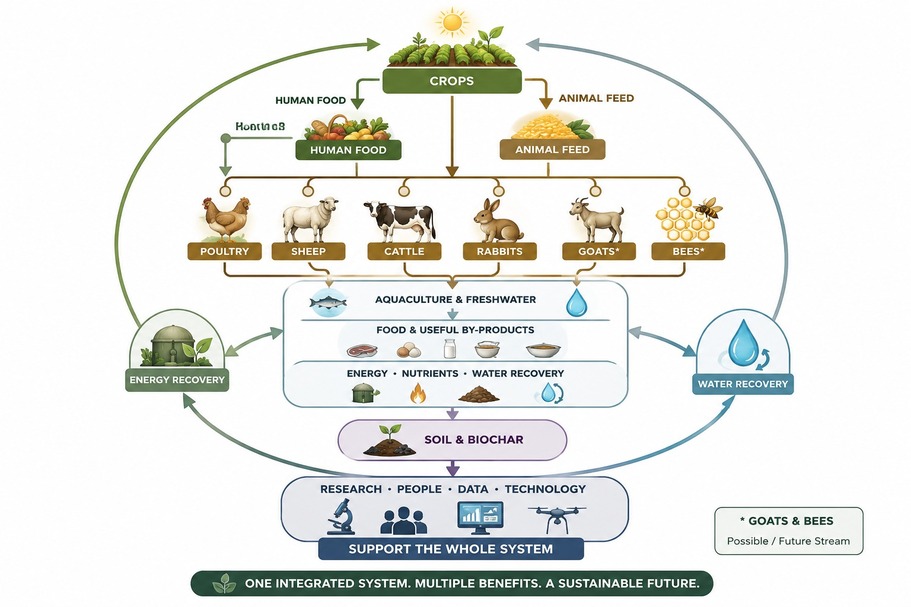
Highland Hills is designed around integration. Crops can become food, feed, and processing inputs. Livestock and processing create useful organic streams. Water can be treated and recovered. Suitable residues can contribute to energy production, compost, soil amendments, and biochar. Wherever practical, the output of one process becomes an input to another.

We grow crops not only for sale, but also as inputs into the wider Highland Hills system. Crops can supply human food, animal feed, processing raw materials and biomass, while crop residues can be recovered for energy or returned to the soil

Our livestock, poultry, fish, crops and vegetable production ultimately produce food for people. Where practical, we want to process and add value to these products ourselves, creating a farm-to-market food system rather than simply selling raw agricultural commodities.

A portion of our crop production and suitable by-products from other processes are used to manufacture animal feed. This reduces dependence on externally purchased feed and allows nutrients and useful materials to remain within the Highland Hills system for as long as possible.

The long-term goal is to create a reliable source of high-quality protein while reducing dependence on imported feed ingredients .Aquaculture has the potential to play a major role in future food production across Africa.

Organic material and biomass that can be beneficially converted can ultimately produce compost, soil amendments, and biochar. These products return nutrients and carbon to the soil, improve soil condition and water retention, and help close the production cycle
Waste streams should not automatically be treated as waste. Manure, organic residues and suitable processing by-products can be used for biogas, thermal energy or other energy recovery processes. Water from production and processing is treated, recovered and reused wherever it is safe and practical, reducing both freshwater demand and discharge.
Fresh. Sustainable. High Quality.